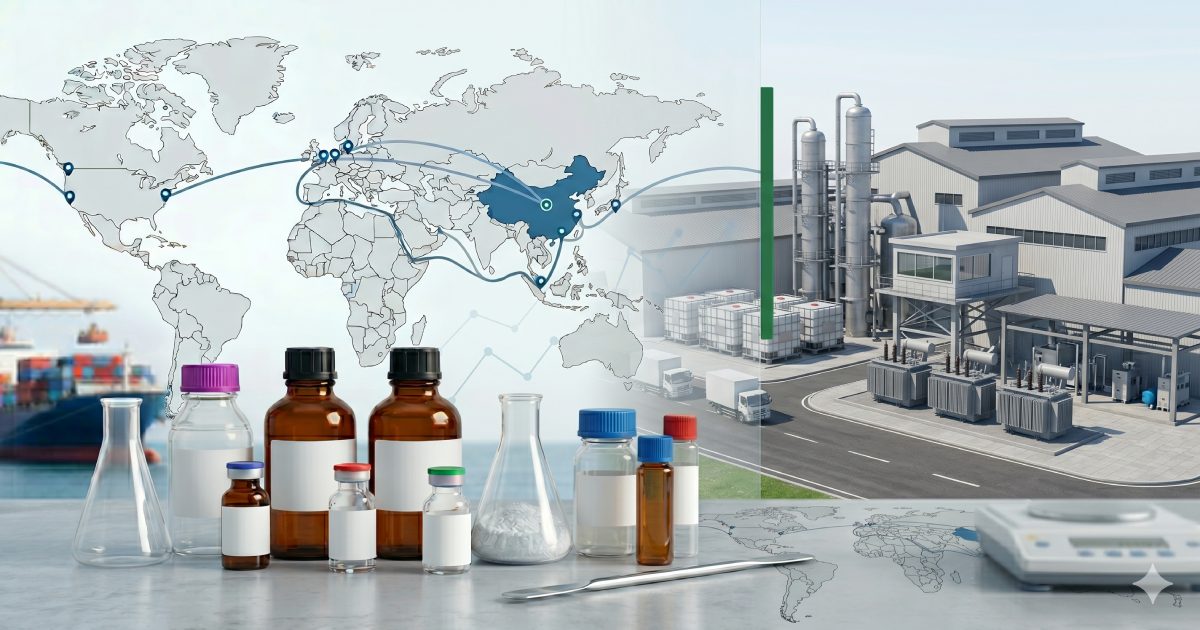
China remains the largest single source of fine chemicals on the global market. In 2025, Chinese exports of APIs and pharmaceutical intermediates reached USD 42.87 billion, with high-end specialty chemicals growing 23.4% year-on-year even as commodity volumes flattened. For procurement teams in pharma, biotech, electronics, and specialty manufacturing, China is not optional — it is the baseline.
But 2026 is not a year for last year’s playbook. Three policy shifts that took effect this spring — an export tax rebate cut, tightened RCEP rules of origin, and a new tariff window for African importers — have changed how landed cost is calculated. Anti-dumping cases in the U.S. and EU have hardened. Buyers who keep using 2024 quote logic will overpay or get caught at customs.
This primer is written for procurement managers and trading houses sourcing research-grade and discovery-grade fine chemicals — APIs, intermediates, click chemistry reagents, PEG derivatives, and similar small-molecule specialty compounds at gram-to-kilogram scale. If you’re sourcing for a regulated commercial pharmaceutical channel (DMF-referenced ANDA filings, EU Marketing Authorization), the rules are different and the bar is higher; that’s a separate guide.
The 2026 Landscape: What Actually Changed
Three regulatory shifts hit between April and May 2026, and all three move the cost math:
Export tax rebates removed on 249 chemical product categories (effective April 1, 2026). This includes methanol, BDO, lithium hexafluorophosphate, and a long tail of intermediates. Suppliers who previously priced with an embedded 13% rebate recovery now have to absorb or pass through that cost. Expect quote increases of 5–13% on affected SKUs versus late-2025 levels — and verify whether your supplier has already repriced or is still quoting at old rates that won’t survive contract.
RCEP rules of origin tightened (effective April 22, 2026). The “de minimis” tolerance for non-originating materials in chemical inputs dropped from 10% to 5%. For ASEAN, Japanese, Korean, Australian, and New Zealand buyers using RCEP preferential tariffs, this is a real squeeze — borderline-qualifying products may now lose preferential status and face full MFN duty. Ask suppliers for an updated origin declaration if you’re claiming RCEP rates.
Zero-tariff access for 53 African countries (effective May 1, 2026). For buyers in African markets with diplomatic relations to China, this is a meaningful new window — particularly for finished APIs and specialty reagents previously priced out by tariffs.
Layered on top: ongoing anti-dumping pressure. The U.S. has proposed ad valorem duties of 172.71%–419.88% on Chinese PTMEG; the EU has imposed provisional duties of 105.6%–113.7% on Chinese 1,4-butanediol. These are narrow product cases, but the trend is real — confirm your specific HS code is not under active investigation before committing to a long contract.
Vetting a Supplier: Beyond the Catalog
Most B2B chemical platforms list thousands of “manufacturers” who are actually traders or brand-only resellers. The distinction matters because it changes price, lead time, batch consistency, and your ability to get technical answers when something goes wrong.
A few practical signals to separate them:
Can the supplier discuss the synthesis route? A source manufacturer can talk through reaction conditions, byproduct profiles, and why a specific impurity might appear in a given batch. A trader will deflect technical questions to “the factory” and come back days later with a written answer. The lag itself is the tell.
Can they put you on a video call inside the production area? Not a polished marketing video — a live walkthrough on Teams or WeChat, on request, with no preparation. Source manufacturers usually can; pure traders usually cannot, because they don’t actually have a factory to show.
Does the CoA carry a traceable batch number that ties back to a production record? Ask for two CoAs from two different batches of the same product. If batch numbering is inconsistent, formatted differently, or the analytical signatures don’t match across batches, you’re likely looking at re-issued documentation rather than original QC.
How fast and how technically is the first response? A response in 4 hours that asks the right scoping questions (scale, intended use, required documentation, target delivery) is worth more than a polished brochure that takes three days.
For deeper due diligence on larger or recurring orders, you can request business license, ISO 9001 certification, hazardous chemicals operating permit, and customs AEO status — but these are second-pass questions, not first-pass blockers. The video walkthrough and the technical conversation tell you more.
Quality Documentation: What R&D Buyers Actually Need
For research, discovery chemistry, and most laboratory-scale applications, the working documentation set is straightforward and well-established across reputable Chinese suppliers:
- Certificate of Analysis (CoA) — including batch number, purity value, the analytical method used (typically HPLC for purity, sometimes GC for volatile compounds), test date, and the QC chemist’s signature.
- Original NMR and HPLC spectra — as PDF exports of the actual instrument trace, not screenshots, and not summary tables. ¹H NMR is standard; ¹³C NMR for structurally complex molecules. LC-MS is increasingly expected for click chemistry reagents, PEG derivatives, and bioconjugation building blocks where mass confirmation matters.
- Safety Data Sheet (SDS) — in the GHS format applicable to your destination market (16 sections; OSHA HazCom 2012 for the U.S., CLP for the EU, JIS Z 7253 for Japan).
- Structural data — SMILES, InChI, and where relevant a CAS-confirmed structure file. For non-CAS-listed novel reagents, ask for the synthetic route summary.
For most R&D and discovery sourcing, that’s the complete package. A purity claim of ≥98% is the working standard for fine chemicals at this scale, and a buyer should verify it against the HPLC trace itself rather than trusting the headline number on the CoA.
If you’re sourcing for a regulated commercial pharmaceutical pipeline — generic ANDA filings in the U.S., EU Marketing Authorization, or ICH-regulated API supply — additional documentation applies (Drug Master File on file with FDA, Certificate of Suitability with EDQM, written confirmation of GMP from a competent authority, ICH Q7 audit history). Suppliers that serve the commercial regulated channel will have these on hand; suppliers that serve the research market typically do not, and that mismatch is a channel difference, not a quality problem. The mistake to avoid is buying R&D-grade material on an R&D-grade quote and then trying to feed it into a regulated pipeline. Decide which channel you’re in before you ask for quotes.
Pricing, MOQ, and Incoterms in 2026
Quotes from Chinese fine chemical suppliers typically tier by scale:
- Gram scale (1g–10g) — usually in stock, ships within a week, priced at a research-grade unit rate. Most click chemistry, PEG derivatives, and discovery-stage APIs are sold this way.
- 100g to 1kg — small-batch custom or scaled-up stock, 2–6 week lead time, 20–40% lower unit price than gram scale.
- Kilogram and above — custom synthesis territory, 6–16 week lead time depending on route complexity, priced per project rather than per gram.
After the April 2026 rebate cut, expect 2026 quotes on affected categories to run noticeably higher than 2025 — confirm with suppliers whether their quote is “post-rebate” pricing.
Incoterms choice is where buyers most often lose money quietly. The trade-offs in 2026 haven’t changed, but they’re worth restating:
- FOB [Chinese port] — seller delivers to vessel; buyer takes risk and arranges main carriage. Best when you have a freight forwarder you trust and want to control shipping cost. Note: for containerized cargo, ICC actually recommends FCA over FOB, because risk should transfer at the container yard, not the vessel rail.
- CIF [destination port] — seller arranges sea freight and minimum insurance to destination port. Convenient for first-time buyers, but the “insurance” under CIF is Institute Cargo Clauses (C), which is bare-minimum cover. If you care about the cargo, take out your own all-risks policy on top.
- DAP [your warehouse] — seller delivers to your door; buyer handles import clearance and duties. Useful for predictable landed cost on the China side, but you still own customs risk on your side.
- DDP — seller handles everything including import duties. Looks attractive, but most Chinese suppliers price DDP with a hefty risk premium and may not actually have the import-side infrastructure to deliver cleanly. Approach with caution.
Standard payment terms in this market are 30% T/T deposit on order confirmation, 70% balance against shipping documents (typically a copy of the bill of lading). For first-time orders or larger amounts, letter of credit at sight is reasonable; for ongoing relationships, T/T 30/70 is the working default. Avoid paying 100% upfront to a new supplier you haven’t vetted, and be alert if the bank account on the proforma invoice doesn’t match the contract entity — that’s a known fraud pattern.
For hazardous goods, factor in UN classification, packaging group, and which carriers will actually accept the shipment. Many fine chemicals fall into UN Class 6.1 (toxic) or 8 (corrosive); air freight options narrow significantly, and some lanes require dangerous-goods certified forwarders. Quote this in early, not after the contract is signed.
Compliance by Destination Market
Customs requirements vary sharply by destination. For research-grade and laboratory shipments, the working baseline:
- United States — TSCA inventory check on the substance (or PMN filing for non-listed compounds), Importer Security Filing (ISF 10+2) at least 24 hours before vessel loading, accurate HS classification, and SDS compliant with OSHA HazCom 2012. Many fine chemicals fall under Section 301 tariffs at 7.5% or 25%; verify the current rate against your HS code before quoting.
- European Union — REACH registration is the binding requirement; the EU operates a “no data, no market” stance. Verify the substance is registered (or under a valid exemption such as PPORD) before importing. CBAM reporting now applies to a widening list of chemical categories — track whether your HS code is in scope.
- United Kingdom — UK REACH operates as a parallel regime post-Brexit; EU registration does not transfer.
- India — CDSCO registration applies for pharmaceutical-use imports; basic customs duty of 7.5–10% plus IGST.
- Brazil — ANVISA registration is required for pharmaceutical-grade material and is famously slow; combined tax burden routinely exceeds 20%.
Confirm compliance documentation in writing before the supplier ships, not after. A shipment held at port for missing paperwork costs more in demurrage and re-export than the original margin on the order.
Red Flags to Walk Away From
A short list of patterns worth treating as deal-breakers, not negotiation points:
- Refusal or stalling on providing original NMR and HPLC spectra
- Quoted price more than 30% below the market band for the same CAS number at the same purity
- Only a proforma invoice on offer; no formal sales contract
- The bank account on the PI doesn’t match the contract entity, or is in a different country
- The same CAS number appears on the supplier’s site at two different purity grades with no explanation
- Refusal to schedule a live video walkthrough of the production area
- “We can match any GMP standard” claimed without a single specific certificate to back it
Any one of these is a reason to slow down and ask harder questions. Two together is a reason to walk.
Building a Long-Term Sourcing Relationship
The buyers who do best in this market treat sourcing as a relationship rather than a series of transactions. Repeat orders unlock things that don’t appear on the first quote: priority production scheduling when capacity is tight, batch reservation for buyers who need lot-to-lot consistency, faster turnaround on custom synthesis feasibility, and direct technical conversations with the QC chemists who actually run the analyses.
That last point is where the trader-versus-source-manufacturer distinction pays off most. Some buyers prefer working directly with source manufacturers that own the synthesis route — eliminating the trader markup, and giving direct access to the chemists who can answer questions about impurity profiles, scale-up feasibility, and batch-to-batch variation. ShellChemTech is one such option, manufacturing APIs, intermediates, click chemistry reagents, and PEG derivatives in-house, with NMR and HPLC verification on every batch.
If you’re working through a sourcing decision and want a quote or a feasibility assessment on a custom compound, request a quote here.